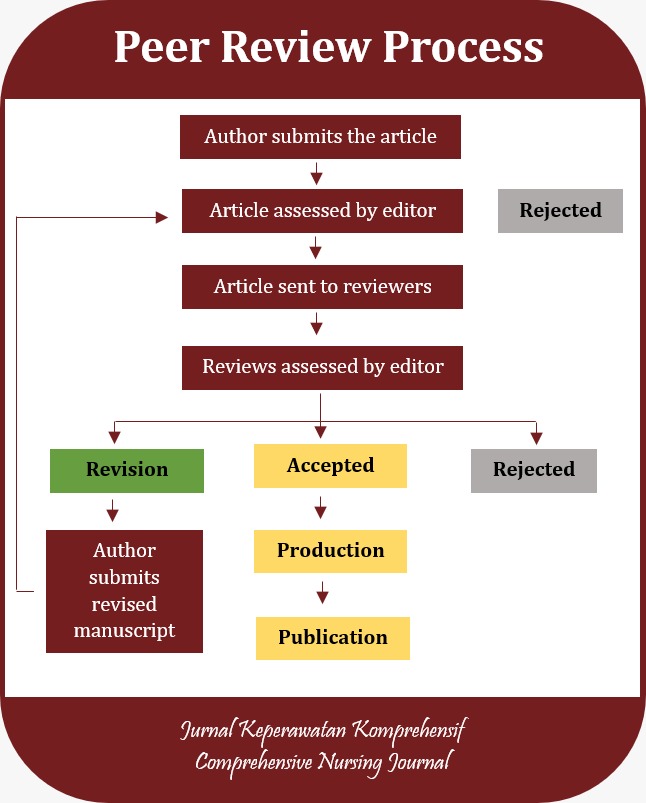
Peer Review Process
Jurnal Keperawatan Komprehensif (Comprehensive Nursing Journal) (JKK) applies a rigorous, independent, and transparent editorial evaluation process to ensure the scientific quality, methodological soundness, originality, ethical integrity, and relevance of published manuscripts.
Initial Editorial Screening
All submitted manuscripts, including original research articles, review articles, and case reports, undergo an initial assessment by the editorial team. This screening evaluates the manuscript's relevance to the journal's aims and scope, compliance with author guidelines, completeness of reporting, research ethics, and originality.
Similarity screening is conducted using appropriate plagiarism-detection software. A similarity index exceeding 20% may trigger additional editorial assessment and a request for clarification or revision. However, similarity percentages are not treated as definitive evidence of plagiarism. Editorial decisions are based on the nature, extent, and context of the overlapping material.
Manuscripts that fail to meet essential editorial or scientific requirements may be returned for preliminary revision or declined before external peer review.
Double-Anonymized Peer Review
Manuscripts that pass the initial screening undergo double-anonymized peer review, in which the identities of authors and reviewers are concealed from one another.
Each manuscript is evaluated by at least two independent external reviewers who are not members of the journal's editorial team or editorial board. Reviewers are selected based on subject expertise, methodological competence, scholarly experience, and independence from the authors.
Reviewers are normally requested to complete their evaluations within 2–4 weeks of accepting the invitation. Extensions may be granted when justified.
Standards for Substantive Peer Review
Reviewers are expected to provide a comprehensive and constructive assessment of the manuscript's scientific contribution and methodological quality.
The evaluation addresses the originality and relevance of the research, clarity of the research objectives, adequacy of the literature review, appropriateness of the study design, sampling procedures, validity and reliability of measurement instruments, data analysis, interpretation of findings, and consistency between results and conclusions.
Reviewers also assess ethical compliance, transparency of reporting, limitations, implications for nursing practice, and adherence to relevant reporting guidelines.
Reviewer reports must contain specific, evidence-based comments identifying issues requiring correction and explaining how the manuscript may be improved. Comments limited to grammatical corrections, formatting issues, or general statements of approval are not considered sufficient substantive reviews.
Editorial Decisions
Following peer review, the handling editor evaluates the reviewers' reports and determines the appropriate editorial decision.
Possible decisions include acceptance, minor revision, major revision, or rejection. When reviewer recommendations differ substantially, the editor may request additional independent assessment.
The final decision is made by the Editor-in-Chief or an appropriately designated independent editor, taking into account the manuscript's scientific merit, reviewer recommendations, author responses, and journal policies.
Revision and Reassessment
Authors receiving revision requests must submit a revised manuscript together with a detailed point-by-point response explaining how each reviewer comment has been addressed.
Where appropriate, authors should identify revised sections, pages, or lines and provide a version with tracked changes.
For major revisions, the revised manuscript may be returned to the original reviewers or evaluated by additional independent reviewers. Minor revisions may be assessed by the handling editor when further external review is unnecessary.
Acceptance is granted only after the editor determines that the manuscript meets the journal's scientific, ethical, and editorial requirements.
Documentation and Quality Assurance
JKK maintains records of reviewer assignments, reviewer reports, editorial decisions, author responses, and revised manuscript versions through Open Journal Systems (OJS).
These records support editorial accountability, internal quality monitoring, and continuous improvement of the peer review process.
Reviewer identities and confidential reports are protected in accordance with the journal's confidentiality policy. Peer review reports are not routinely published alongside articles.
Copyediting, Production, and Publication
Following acceptance, manuscripts proceed to copyediting, layout preparation, proofreading, and final production checks.
Authors may be invited to review the galley proof for factual and typographical corrections. Substantive changes after acceptance require editorial approval.
Publication scheduling is managed separately from the peer review decision process. Acceptance is based on scientific and editorial merit rather than publication quotas, article processing charges, or predetermined issue composition.